

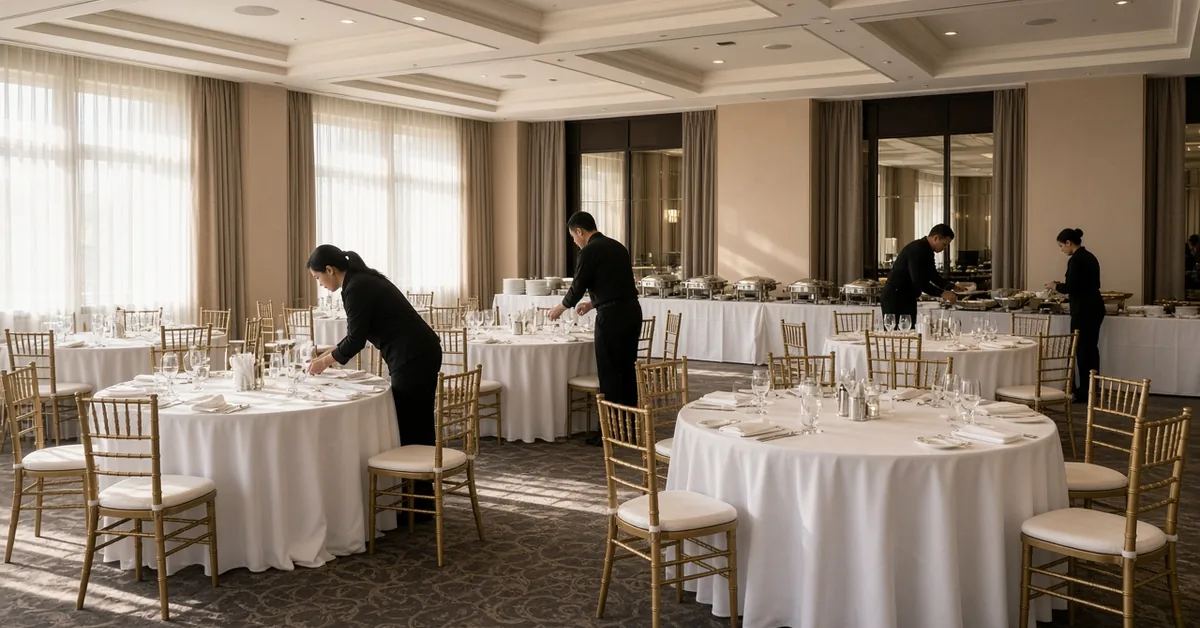
For a straightforward catered event, start by allowing roughly two hours for setup and one hour for clearance, plus a separate contingency buffer. More elaborate celebrations may need substantially longer. The right booking covers everything from the first supplier entering to the final handover, not just the time guests spend celebrating.
Before confirming a venue in Singapore, work backwards from guest arrival and forwards from guest departure. This reveals whether the quoted hours genuinely fit your plans.
Check What the Hire Period Actually Covers
Event hours are the period reserved for guests and the programme. Venue hire hours are the access period agreed with the venue. Depending on the package, setup and teardown may fall within that period or have separate allowances.
For example, a four-hour booking could leave only two hours for guests if setup takes 90 minutes and clearance takes 30 minutes. Never assume early supplier access is complimentary.
When comparing Rasa Catering’s venue options, request four written timings: earliest supplier entry, guest admission, event finish and final handover. Also clarify whether “finish” means guests must leave or the room must already be empty and restored.
Use These Setup and Cleanup Estimates as a Starting Point
These are planning estimates, not standard Singapore venue rules or guaranteed supplier turnaround times. Confirm them against your actual layout, equipment and crew.
| Event arrangement | Setup allowance | Clearance allowance |
|---|---|---|
| Small gathering with furniture already arranged and minimal décor | 1–2 hours | 45–60 minutes |
| Buffet reception with registration, simple décor and basic audio | 2–3 hours | 1–1.5 hours |
| Wedding or corporate event with staging, substantial décor and technical equipment | 4–6 hours or more | 2–3 hours or more |
Add a separate buffer of around 30–60 minutes for a straightforward event, increasing it where access or supplier coordination is difficult. Major installations may require a separate setup day. Discuss that before booking.
Guest count alone does not determine timing. A small celebration with a complex backdrop can require longer than a larger lunch in an already furnished room.
Build Setup Time Around the Work That Must Happen First
Ask every supplier for an arrival time, unloading duration, setup duration and ready time. “We need an hour” is ambiguous if it excludes carrying equipment upstairs.
Check the delivery route during a site visit. Can vehicles unload near the room? Is there a service lift, and must it be reserved? Does building management require contractor registration or delivery approval?
At a condominium function room or managed building, confirm who can unlock the space and authorise deliveries. A supplier arriving before the booking starts may have nowhere to unload. Share the room contact’s name and phone number with each team, and check that the service lift remains available during collection.
Sequence tasks that depend on each other. Furniture placement should be settled before table dressing. A stage must be ready before equipment testing. Keep the buffet area accessible until catering setup is complete.
Some teams can work simultaneously, but only if they have separate working space and sufficient access. Two suppliers sharing one service lift may need staggered deliveries.
Set a room-ready deadline before guest admission. Reserve the final 15–30 minutes for checking microphones, clearing packaging, confirming signage and briefing staff. If early guest arrival is likely, agree where people can wait safely.
For an outdoor setup, include the time needed to move furniture and serving equipment to the agreed sheltered area if conditions change. Confirm that this backup space is available for both setup and clearance, rather than only during guest hours.
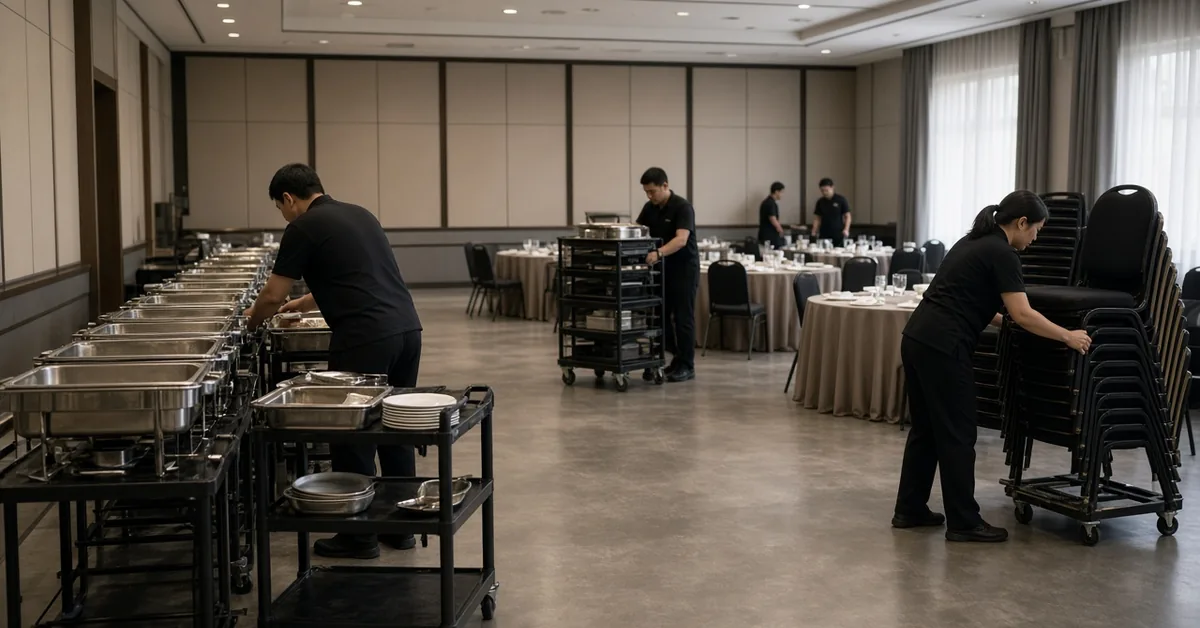
Match Catering Timings to the Venue Booking
Catering has its own delivery, service and collection schedule. Those timings must fit inside the venue’s permitted access.
Rasa’s published outdoor catering guidance states that food is set up 30 minutes to one hour before the event, with the team returning for clearance three hours after the stated event time. It also requests a 30-minute delivery grace period before or after the scheduled delivery time.
Treat these as catering arrangements to confirm for your order. They do not cover the time needed to prepare the entire room. Agree a delivery slot that accommodates the grace period and still meets your serving deadline.
Collection starting at 3pm does not mean equipment will be removed by 3pm. Ask when clearance will finish. A longer venue booking also does not extend Rasa’s stated three-hour food consumption period; discuss any later meal service separately.
Example: A Three-Hour Lunch Reception
Suppose guests attend from noon to 3pm, with simple décor, a buffet and basic audio. A workable draft schedule might look like this:
| Time | Activity |
|---|---|
| 9.30–10am | Supplier access, unloading and room inspection |
| 10–11am | Furniture, décor, registration and audio setup |
| 11am–noon | Agreed catering setup, final checks and team briefing |
| Noon–3pm | Guest reception and meal service |
| 3–3.15pm | Guest departure; catering clearance begins where safely accessible |
| 3.15–4.15pm | Equipment removal, décor dismantling and cleaning |
| 4.15–4.30pm | Room inspection and handover |
| 4.30–5pm | Contingency allowance before access ends |
This requires 7.5 hours of access for a three-hour guest programme. It is an illustration, not a Rasa package or promised schedule. Supplier availability, the venue’s booking blocks and actual clearance requirements may change it.
If the venue only offers fixed sessions, check which combination covers the entire timeline. A session ending at 4pm would not accommodate this example without reducing the workload or agreeing additional access.
Give Cleanup a Defined Scope and an Owner
“Cleanup included” needs clarification. Catering equipment collection, rubbish removal, décor dismantling, floor cleaning and furniture restoration are separate tasks.
Confirm who removes food waste and packaging, where waste must go, and whether tables and chairs must return to their original positions. Ask whether any cleaning fee covers routine cleaning only, with additional charges for spills or excessive rubbish.
Book collection times with every rental supplier. Do not leave equipment overnight unless the venue has approved storage and later access in writing.
Allow a short departure period before dismantling begins around guest areas. Guests collecting belongings and saying goodbye can delay clearance, especially when everyone uses the same exit.
Nominate one organiser to stay for the inspection, record the room’s condition and obtain handover confirmation. The host should not discover at closing time that every supplier has left but nobody has checked the room.
Confirm Overtime Terms Before Paying the Deposit
Ask whether extra time is charged by the hour, part-hour or booking block. Check whether extended access brings additional staffing, security, air-conditioning or cleaning costs.
Ask whether complimentary setup access includes power, lighting and air-conditioning. An unlocked room is of limited use if technicians cannot test equipment or suppliers cannot safely complete their work.
Frequently Asked Questions
Does venue hire include setup and cleanup?
Check your package; both may count within booked hours.
How much setup time should I allow?
Allow 1–2 hours for simple setups, subject to supplier confirmation.
How long does event cleanup take?
Simple events may need 45–60 minutes; elaborate setups take longer.
Should I add a buffer for delays?
Allow 30–60 extra minutes, increasing this for complex arrangements.
Can suppliers collect equipment the next day?
Only with written approval for storage and collection access.